MES vs ERP: Which System Does Your Manufacturing Need?
💡 Key Takeaways
- ERP handles business-level planning (finance, procurement, HR); MES handles real-time shop floor execution (production tracking, quality, traceability).
- Companies with fewer than 50 employees and simple production processes may only need ERP initially.
- MES provides real-time production visibility and granular traceability that ERP systems cannot deliver.
- Using ERP as a substitute for MES creates data latency, poor user adoption, and costly blind spots on the shop floor.
- The best approach for complex manufacturing operations is MES + ERP integrated, with each system handling what it does best.
- Cloud-based MES solutions like ProductFlow make implementation accessible in weeks rather than months, at a fraction of traditional MES costs.
If you run a manufacturing operation, you have almost certainly encountered two acronyms that dominate the enterprise software landscape: MES (Manufacturing Execution System) and ERP (Enterprise Resource Planning). Both promise to streamline your processes, reduce costs, and improve visibility. But they serve fundamentally different purposes, and choosing the wrong one—or deploying them incorrectly—can cost your organization hundreds of thousands of dollars and months of lost productivity.
In this guide, we break down the differences between MES and ERP, explain when each system excels, and help you decide whether your shop floor needs one, the other, or both.
What Is an ERP System?
An Enterprise Resource Planning system is the backbone of business-level operations. ERP software integrates core business processes—finance, human resources, procurement, inventory management, sales, and supply chain logistics—into a single platform. Think of ERP as the system that answers questions like "How much did we spend on raw materials last quarter?" or "When will Purchase Order 4521 arrive?"
Leading ERP solutions such as SAP S/4HANA, Oracle NetSuite, and Microsoft Dynamics 365 focus on planning and transactional data. They handle master data management, bill of materials (BOM) definitions, customer orders, invoicing, and financial reporting. ERP systems operate at the business level, typically dealing with time horizons measured in days, weeks, or months.
Key ERP Functions in Manufacturing
- Material Requirements Planning (MRP): Calculating what materials are needed, when, and in what quantities based on demand forecasts and existing inventory.
- Financial Management: General ledger, accounts payable/receivable, cost accounting, and budgeting.
- Supply Chain Management: Vendor management, purchase orders, logistics tracking, and warehouse management.
- Production Planning: High-level scheduling, capacity planning, and work order generation.
- Human Resources: Payroll, time tracking, compliance, and workforce planning.
An ERP system gives you a bird's-eye view of your entire business. It excels at answering strategic questions and managing cross-departmental workflows. However, ERP systems typically lack the granularity required to manage what happens on the shop floor in real time.
What Is a Manufacturing Execution System (MES)?
A Manufacturing Execution System bridges the gap between business planning (ERP) and the physical production floor. MES software monitors, tracks, and controls manufacturing processes as they happen. It answers questions like "What is the current status of Work Order 1089?" or "Did the operator complete the required inspection at Station 3?"
MES operates in real time. It collects data from machines, sensors, and operators, and uses that data to enforce process discipline, ensure quality, and provide granular production tracking. Where ERP thinks in days, MES thinks in seconds and minutes.
Key MES Functions
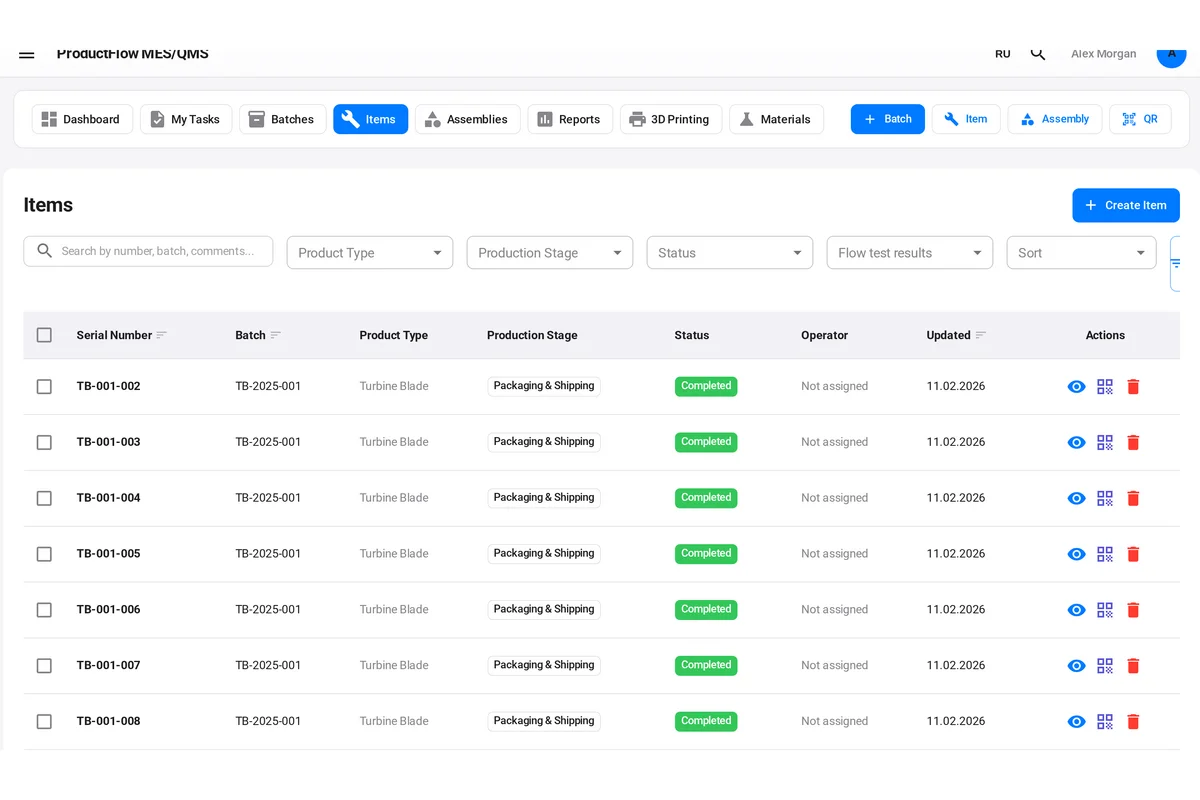
- Real-Time Production Tracking: Monitoring the status of every work order, batch, and individual part as it moves through production stages.
- Shop Floor Data Collection: Capturing machine parameters, cycle times, scrap counts, operator actions, and environmental data.
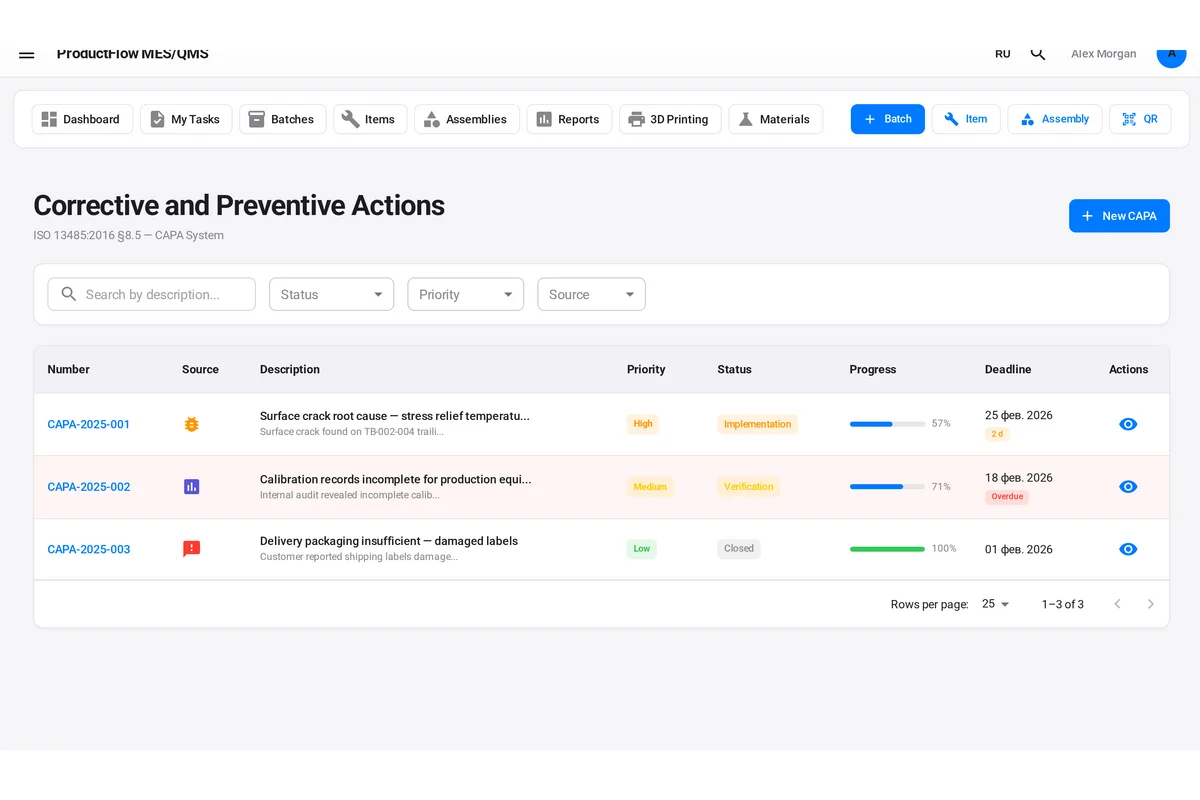
- Quality Management: Enforcing inspection checkpoints, managing non-conformance reports (NCRs), tracking corrective actions (CAPAs), and maintaining full traceability.
- Process Enforcement: Ensuring operators follow the correct sequence of steps, use the right tools, and record the required data before moving to the next operation.
- Genealogy and Traceability: Maintaining a complete record of every material, process, and person involved in producing a specific part or batch—critical for industries subject to ISO 9001, AS9100, or FDA regulations.
- Performance Analytics: Calculating OEE (Overall Equipment Effectiveness), identifying bottlenecks, and providing actionable dashboards for production managers.
MES vs ERP: Head-to-Head Comparison
The following table highlights the core differences between MES and ERP across the dimensions that matter most to manufacturing operations:
| Dimension | ERP | MES |
|---|---|---|
| Primary Focus | Business planning, finance, supply chain | Shop floor execution, real-time production |
| Time Horizon | Days, weeks, months | Seconds, minutes, hours |
| Data Granularity | Order-level, batch-level | Part-level, operation-level, sensor-level |
| Users | Finance, procurement, management | Operators, supervisors, quality engineers |
| Quality Management | Basic (record defects after the fact) | In-process (enforce inspections, real-time SPC) |
| Traceability | Lot/batch-level | Serialized, full genealogy per unit |
| Machine Integration | Limited or none | Direct (OPC-UA, MTConnect, IoT sensors) |
| Scheduling | High-level capacity planning | Detailed sequencing, dynamic rescheduling |
| Reporting | Financial, inventory, sales reports | OEE, cycle times, scrap rates, yield |
| Typical Cost | $50K–$500K+ (SMB to enterprise) | $20K–$300K+ depending on scope |
When ERP Is Enough
Not every manufacturer needs a dedicated MES. If your operation meets the following criteria, ERP alone may serve you well:
Low-Complexity, High-Volume Production
If you produce a small number of SKUs in large batches with simple, well-established processes, ERP's production planning and inventory modules may provide sufficient visibility. Commodity manufacturing—standard fasteners, basic packaging, bulk chemicals—often falls into this category.
Minimal Regulatory Requirements
If your industry does not require serialized traceability, in-process inspections, or detailed production records, ERP's batch-level tracking is usually adequate. Many distribution-focused businesses and light assembly operations can rely on ERP for basic quality records.
Small Team, Limited Budget
For very small operations with fewer than 20 production employees, the overhead of a separate MES may not be justified. In these cases, ERP combined with spreadsheets or simple shop floor tools may be the pragmatic choice—at least initially.
When You Need MES
MES becomes essential when your manufacturing operation requires one or more of the following:
Real-Time Shop Floor Visibility
If you frequently find yourself walking to the production floor to check on order status, or if your production managers cannot answer "Where is this job right now?" without making phone calls, you need MES. Real-time production tracking eliminates guesswork and gives everyone—from the operator to the CEO—a single source of truth.
Regulated Industries and Audit Readiness
Aerospace (AS9100), medical devices (ISO 13485, FDA 21 CFR Part 820), automotive (IATF 16949), and defense manufacturing all require detailed, serialized traceability. Auditors expect you to trace any finished product back to its raw materials, process parameters, operator certifications, and inspection results. ERP simply cannot provide this level of detail. MES can.
Complex, Multi-Step Processes
If your products go through 10, 20, or 50+ process steps—each with different machines, tooling, and quality checks—MES ensures nothing is missed. This is especially critical in additive manufacturing, precision machining, and electronics assembly, where a single skipped step can result in catastrophic field failures.
Quality as a Competitive Advantage
When your customers demand certificates of conformance, first-article inspection reports, or statistical process control data, MES automates the collection and generation of these documents. Manual quality systems based on paper travelers and spreadsheets do not scale, and they introduce errors that erode customer confidence.
Continuous Improvement Initiatives
Lean manufacturing, Six Sigma, and OEE programs all depend on accurate, granular data from the shop floor. MES provides the data foundation that makes these initiatives actionable rather than aspirational. Without MES data, your improvement efforts are based on estimates and anecdotes.
When You Need Both MES and ERP
In practice, most mid-size and large manufacturers benefit from running both systems together. The key is understanding their complementary roles:
The Integration Model
ERP handles the "what" and "when" at a macro level: what products to make, when to order materials, and how much everything costs. MES handles the "how" at the micro level: how the product is actually being made, whether quality standards are being met, and what is happening right now on the shop floor.
A well-integrated MES-ERP architecture typically works like this:
- ERP creates work orders based on customer demand and production plans.
- Work orders flow to MES, which breaks them into detailed operation sequences with routing, tooling, and inspection requirements.
- MES executes and tracks production, collecting real-time data from operators and machines.
- MES reports completions back to ERP, updating inventory levels, consuming raw materials, and enabling invoicing.
- MES quality data feeds ERP for cost-of-quality analysis and customer reporting.
This bidirectional flow ensures that business planning stays synchronized with shop floor reality—a synchronization that is impossible when ERP is the only system in play.
Common Integration Points
- Work order release and status updates
- Bill of materials and routing synchronization
- Inventory transactions (material consumption, finished goods receipt)
- Labor time reporting
- Quality hold and disposition notifications
The Hidden Costs of Using ERP as MES
Many manufacturers attempt to stretch their ERP system to cover MES functions. This approach almost always fails for several reasons:
Performance degradation: ERP databases are optimized for transactional processing, not real-time event streaming. Forcing thousands of shop floor events per hour through an ERP system creates bottlenecks and slows down business-critical financial transactions.
Poor user experience: ERP interfaces are designed for office workers, not shop floor operators wearing gloves and working in noisy environments. The result is low adoption, workarounds, and data quality issues.
Excessive customization: Bending ERP to track shop floor details requires expensive custom development that is fragile, hard to upgrade, and difficult to maintain. These customizations often cost more than a purpose-built MES.
Incomplete traceability: ERP's data model typically lacks the granularity to support serialized, operation-level traceability. Bolt-on solutions create data silos and gaps that auditors will find.
How to Choose the Right System
When evaluating MES vs ERP for your manufacturing operation, consider these decision factors:
Start With Your Pain Points
If your biggest challenges are financial visibility, procurement efficiency, or inventory accuracy, invest in ERP first. If your challenges are production visibility, quality control, on-time delivery, or regulatory compliance, prioritize MES.
Consider Your Growth Trajectory
Manufacturers that are scaling up—adding new product lines, entering regulated markets, or winning contracts with demanding OEMs—will inevitably need MES. Investing early avoids the pain of retrofitting traceability into an already-running production environment.
Evaluate Total Cost of Ownership
Compare the total cost of ERP customization to achieve MES-like functionality versus deploying a dedicated MES. In almost every case, the dedicated MES is less expensive, faster to deploy, and easier to maintain. Modern cloud-based MES solutions have dramatically reduced implementation timelines from 12–18 months to as little as 4–8 weeks.
Look for Modern, Integrated Platforms
The latest generation of manufacturing software blurs the line between MES and QMS (Quality Management System). Platforms that combine production tracking, quality management, and traceability in a single system eliminate integration headaches and provide a unified experience for shop floor teams.
ProductFlow: Modern MES + QMS for Manufacturing
ProductFlow combines real-time production tracking, quality management, and full traceability in one platform. Purpose-built for precision and additive manufacturing, it deploys in weeks—not months. See pricing or learn more about ProductFlow.
📋 Quick Assessment: Do You Need MES, ERP, or Both?
Answer 5 quick questions to get a personalized recommendation for your manufacturing operation.
1. How many production steps does your typical product go through?
2. How do you currently track work-in-progress?
3. What's your biggest operational pain point?
4. How important is part-level traceability?
5. What's your team size on the shop floor?
Key Takeaways
Choosing between MES and ERP is not an either/or decision for most manufacturers. Here is the summary:
- ERP is essential for business-level planning: finance, procurement, inventory, and supply chain management.
- MES is essential for shop floor execution: real-time tracking, quality enforcement, traceability, and process control.
- Using ERP as MES leads to expensive customization, poor shop floor adoption, and incomplete traceability.
- The best results come from running both systems together, with clear integration between business planning and production execution.
- Modern MES/QMS platforms like ProductFlow dramatically reduce the cost and complexity of achieving shop floor visibility and regulatory compliance.
Whether you are a small job shop considering your first digital system or a mid-size manufacturer outgrowing your ERP's production module, understanding the distinct roles of MES and ERP is the first step toward building a manufacturing technology stack that actually works.